
Blanket Hogs and Thermostat Fights: The Fun Facts Hiding in a National Sleep Survey
I’ve rarely had a full, uninterrupted night of sleep in almost five years. Between a toddler who treats 5:15 a.m. like prime time and an almost-five-year-old who has strong opinions about which stuffed animal is allowed in bed (all of them, apparently), quality sleep in my house is more of a rumor than a routine. So when I came across Bear Mattress’s recent sleep habits study, I didn’t just skim it out of professional curiosity — I read it the way a tired parent reads anything promising answers about sleep.
But the more I got into it, the more it hooked me for reasons that had nothing to do with my kids. A few things stood out right away: the data itself was genuinely interesting, public health research is my passion, and there was an unexpected tie-in connecting back to electric utilities – the industry where I cut my teeth in research nearly 20 years ago and still do a ton of work in to this day. A mattress company, a sleep study, and a tie-in to how people actually use their thermostats. I wasn’t expecting to find all three in one place.
Can we talk about the methodology for a second?
I promise this is more interesting than it sounds. As a researcher, I can’t read a study like this without checking under the hood first, and this one held up. Bear Mattress fielded the survey with PureSpectrum, which happens to be one of my favorite panel partners to work with — they consistently deliver clean, well-behaved samples. The study surveyed 2,119 U.S. adults across all 50 states, used quotas to keep state-level representation reasonably balanced (between 31 and 58 respondents per state), and screened out low-quality responses before analysis. That’s a solid sample size, a thoughtful sampling approach, and real quality control — not something you can say about every “survey says” story that crosses your feed. So, hats off to their team. It made the findings a lot easier to trust.
Oklahomans – We’ve got some sleep to catch up on
Buried in the state-by-state breakdown is a sleep comfort ranking, and it’s a little brutal if you live in Oklahoma like we do. Nevada came out on top with a sleep comfort score of 57.6 out of 100, while Oklahoma landed dead last at 37.3. I don’t know exactly what’s driving that gap — climate, mattress age, stress levels, who knows — but it’s the kind of stat that makes you want to dig deeper, which is exactly what a good data point should do.
The thermostat gap – where my public health and utility research worlds collided
Another finding that really got me thinking was on the temperature settings people reported. Energy companies (and the Department of Energy) have long recommended keeping your thermostat around 78 degrees in the summer for cost and efficiency reasons. Meanwhile, this study found the average ideal sleep temperature Americans actually want is 67 degrees — eleven degrees cooler than the “official” guidance. And it’s not just wishful thinking either: in an older survey by Consumer Reports, not a single central air respondent in the study reported setting their thermostat above 76 degrees in the summer.
That gap between recommended behavior and actual behavior is basically the entire premise behind every energy efficiency and demand-response campaign I’ve ever worked on. People know what they’re “supposed” to do, and they do something else anyway, because comfort wins. There’s also real regional variation baked in. In the sleep survey, Massachusetts respondents reported sleeping coldest at 63.2 degrees, while Hawaii ran warmest at 69.5. Even the warmest-sleeping state in the country still lands well below what utilities recommend.
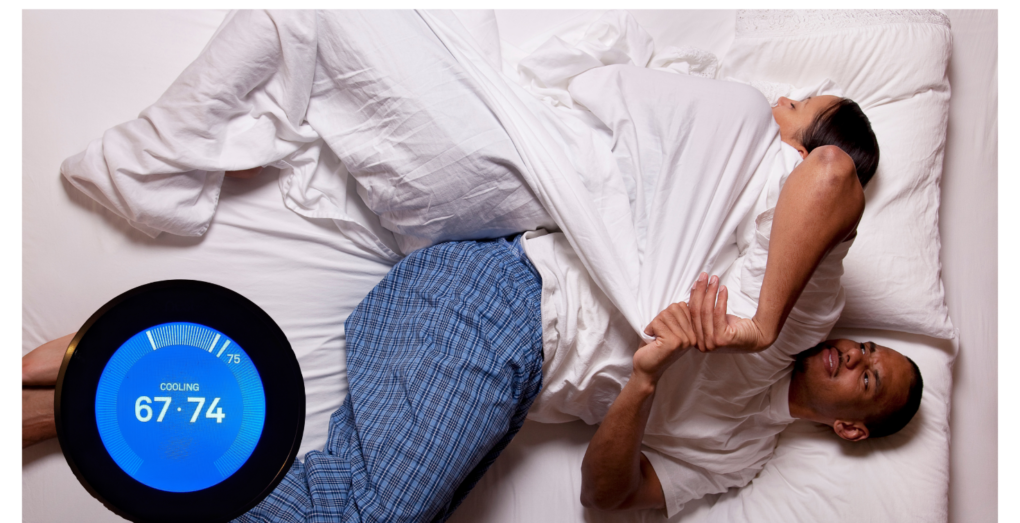
And it’s not just an individual preference thing — it’s a relationship thing. Twenty-two percent of couples say they frequently or occasionally disagree about bedroom temperature, and women were noticeably more likely to report overheating at night than men (47% versus 38%). If you’ve ever fought over the thermostat with a partner, you are extremely not alone.
A few random facts I can’t stop thinking about
Beyond the headline findings, a handful of smaller stats stuck with me — the kind of thing you bring up at dinner and everyone has an opinion about.
Gen Z is out here sleeping with their phones in bed at a much higher rate than everyone else — 43% keep their phone in the bed itself, compared to 29% of all adults overall. I know many parents who bed-share with their kids — but bed-sharing with your phone — c’mon!
Another interesting finding — most couples don’t even go to bed at the same time — only 39% do. I’ve heard of some couples doing this, but I never thought I’d be in the minority who goes to bed at the same time as my wife.
And then there’s the blanket situation. Seventy percent of people believe blanket theft is a real phenomenon in their household, and 35% are willing to name their partner as the culprit. This one I can relate to! The proposed solution, which a quarter of couples have already adopted, is what’s sometimes called the Scandinavian sleep method — everyone gets their own blanket, no sharing, no negotiating, no 2 a.m. tug-of-war. This may need to be implemented in my home.
Why this study stuck with me
This one stuck because it did what good research is supposed to do: it used a credible methodology to surface findings that are genuinely useful (there's real public health value in understanding how poorly Americans sleep) and genuinely fun (blanket hogs, phone habits, thermostat wars). That’s something we aim to do on every study here at Evolve.
Not to mention, it covered two areas of research where I spend a lot of my time — public health and utilities. And selfishly, it gave me something to think about besides counting down the hours until my kids' next 5 a.m. wake-up call.
If nothing else, I'm going to go tell my wife that 67 degrees has science on its side.
Posted by
-
 Stewart LawDIRECTOR OF STRATEGY